





A heat pump installation takes two to four days at your home, after a survey that lasts one to three hours. The installer puts a heat pump unit outside, runs two water pipes into the house, fits a hot water cylinder and swaps any radiators that are too small. Then they fill and test the system, show you the controls and register it with MCS, which is what releases the government grant. From saying yes to a quote to switching on usually takes about two weeks. Below is each part, with drawings of the heat pumps we fit.
At a glance
What gets installed?
Most installations change five things in your home. Here they are, from the outside in.
The heat pump outside
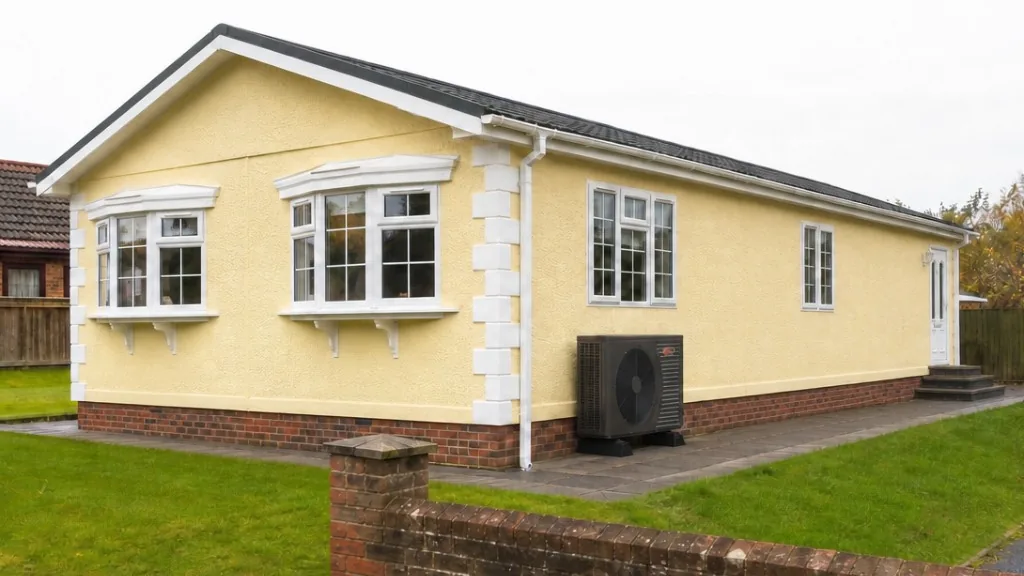
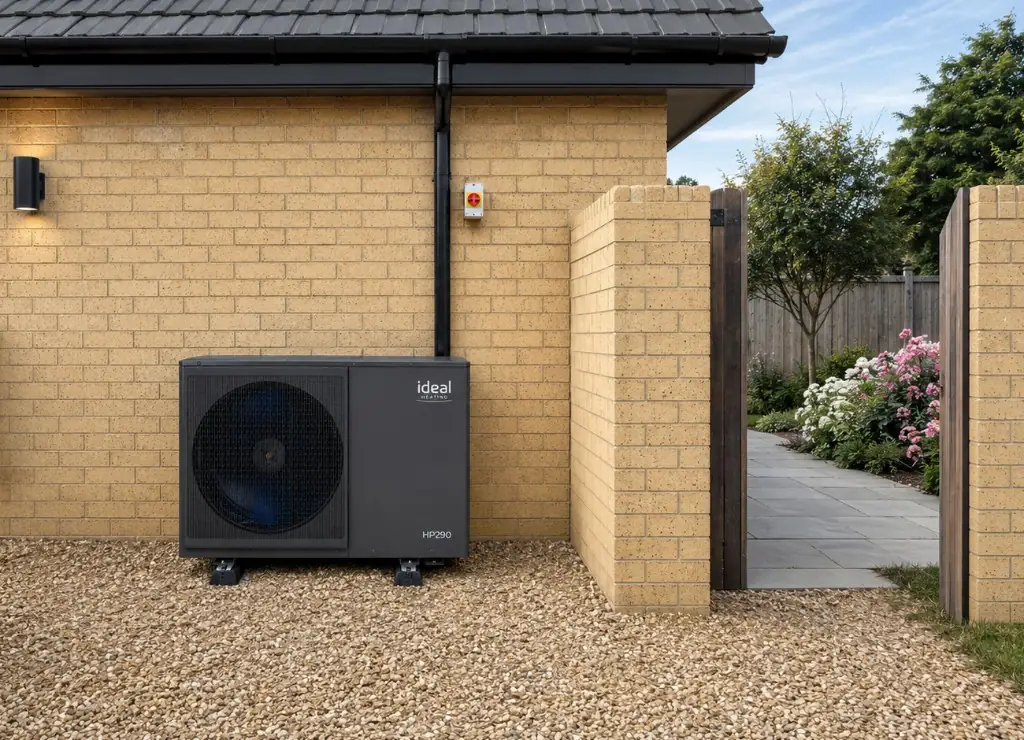
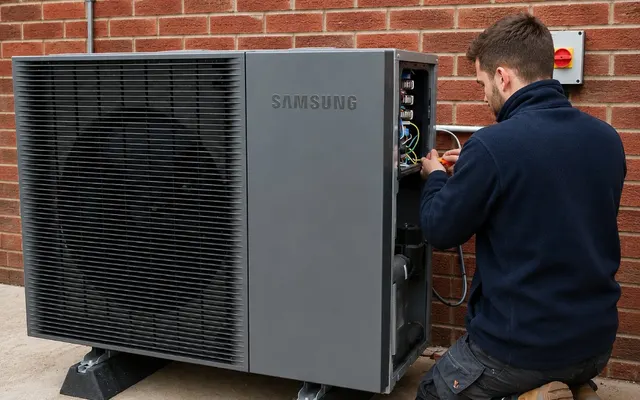
This is the part you will notice. It is a metal box a little bigger than a washing machine, and it takes heat from the outside air, even on a cold day. The heat pumps we fit are monobloc units: the refrigerant stays sealed inside the box, so no refrigerant pipes come into your home.
Two water pipes
Two insulated pipes run from the unit through the wall. One carries warm water in, the other takes cooler water back out. Indoors they join your heating pipes, so your radiators stay where they are.
A hot water cylinder
A heat pump can’t heat water instantly the way a combi boiler does, so it heats a tank of hot water instead. If you have a combi now, the cylinder needs a home: an airing cupboard, a utility room or a garage often works. The survey checks where it fits and what size you need.
INDOORS
What goes in the cylinder cupboard
- Hot water cylinder. Stores your hot water. A coil inside carries heat from the heat pump. It is sized for your household.
- Expansion vessel. Gives the water room to expand as it heats up.
- Diverter valve. Sends the heat to your radiators or to the cylinder, whichever needs it.
- Pressure-reducing valve. Keeps the cold mains water coming in at a safe pressure.
- Tundish. A safety outlet with a visible gap, so you can see if a relief valve has opened.
Radiators
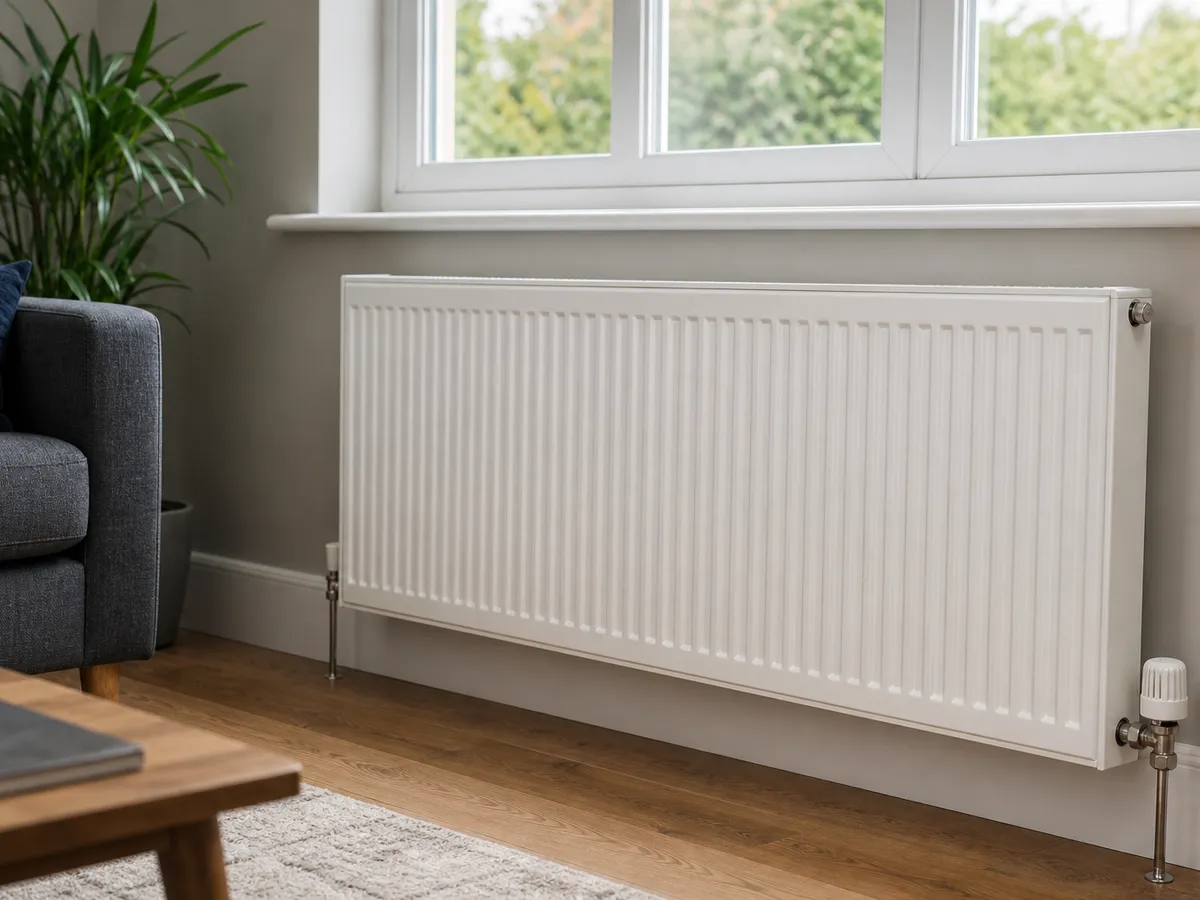
Many homes keep the radiators they have. Where a room would need more heat, the survey may recommend a bigger one, and the section on radiators below explains why.
Controls and electrics
You get a controller on the wall, a new circuit from your fuse box and an isolator switch next to the outdoor unit. The old boiler is disconnected once the new system is ready.
How big is a heat pump?
Bigger than a boiler, smaller than most people expect. The heat pumps we fit stand 80 to 97 cm tall and 1 to 1.4 m wide, so about waist height. They weigh 80 to 130 kg, which is why they sit on a concrete pad or strong wall brackets.
DRAWN TO SCALE
How big is the outdoor unit?
| Brand | Size | Height × width | Weight |
|---|---|---|---|
| Samsung | 8 kW | 85 × 100 cm | 98 kg |
| Vaillant | 7 kW | 96 × 110 cm | 128 kg |
| Ideal | 8 kW | 86 × 138 cm | 117 kg |
| Trianco | 9 kW | 80 × 117 cm | 80 kg |
A home that loses more heat needs a more powerful heat pump, and more powerful usually means a bigger box. The survey sets the size, so you are not paying for more than you need. The brands and sizes we offer are on our heat pump page.
Where can the outdoor unit go?
Most homes have a spot that works: a side return, a back wall or a corner of the garden. Three rules decide where.
- Room to breathe. The unit blows air out of the front, so it needs clear space there, and a gap behind it.
- A safety zone. Our heat pumps use R290, a natural refrigerant. The installation manuals ask for a zone of around a metre around the unit with no windows, doors, air vents or drains in it.
- Quiet enough for next door. In England, the predicted noise at your neighbour's nearest window must be 37 dB(A) or less for the install to go ahead without planning permission.
WHERE IT CAN GO
The rules for placing the outdoor unit
If no spot passes all three, the installer can suggest a quieter model, a different wall or a planning application.
No room outside at all? An indoor heat pump is another option. It fits in a cupboard, a garage or a loft and draws air through two vents in an outside wall, so there is no unit in the garden. Indoor models come in smaller sizes, up to about 5 kW, so they suit homes that need less heat, such as flats and smaller houses. The survey tells you whether yours is one of them. Our guide to the MCS 020 noise rule explains how the noise check is worked out, and the heat pump noise guide puts 37 dB(A) in everyday terms.
How long does a heat pump installation take?
About two weeks from saying yes to a warm house, plus the survey before it. The fitting itself is two to four days.
TIMELINE
From first call to warm radiators
Before the first day
- The survey. Someone visits for one to three hours. They measure every room, check where the outdoor unit and cylinder can go, and look at your radiators and fuse box.
- Your quote. You get a fixed price and an estimate of how the system will perform. MCS rules require that estimate before you sign.
- The grant. We apply for the Boiler Upgrade Scheme grant. You get an email from Ofgem to confirm, and the grant comes straight off your bill.
At your home, day by day
- Day 1. The outdoor unit goes in, the pipes go through the wall and the old system is drained.
- Day 2. The cylinder goes in, any bigger radiators go up and the controls are wired.
- Day 3. The system is filled, tested and set up. You get a walkthrough of the controls, and your MCS certificate follows.
A home with no radiator changes can be done in two days. A larger home with several new radiators can take four. Your heating will be off for part of the fitting, and hot water for part of a day.
Will my radiators need changing?
Possibly, but it depends on your current setup, and we check every room during the survey. Many homes need no changes at all. A gas boiler sends water to your radiators at around 60 to 70°C. A heat pump works best at 35 to 50°C. Cooler water means each radiator gives out less heat, so a room that is only just warm enough today may need a bigger one. The survey works this out room by room.
Why not just run the heat pump hotter? Because it costs more to run. This chart uses the manufacturers’ own figures.
WHY RADIATORS MATTER
Cooler water, cheaper heat
| Heat pump | 35°C | 55°C |
|---|---|---|
| Samsung 8 kW | 4.66 | 3.41 |
| Ideal 8 kW | 5.07 | 3.82 |
That is why a good installer upsizes a few radiators rather than turning the water temperature up. Our guide to heat pump radiators goes into the detail, and heat pump running costs shows what it means for your bills.
How much disruption should you expect?
Less than most people fear, but more than a boiler swap.
Do
- Clear a path to the cylinder cupboard and to any radiator being changed.
- Book the fitting for a mild week if you can.
- Keep a kettle and a plug-in heater handy for the day the heating is off.
Don't
- Book decorating for the week before. New radiators can leave marks on walls.
- Expect it to behave like a boiler. It runs for longer at a gentler temperature, and that is normal.
When isn’t a heat pump the right choice?
A heat pump suits most UK homes, but not every one.
- There is no outside spot that meets the safety zone and noise rules, and the home needs more heat than an indoor heat pump can give.
- The home is very draughty with little insulation. Sort that first, or the heat pump has to be bigger and costs more to run.
- It is a listed building, or a flat where the freeholder won't give permission.
In Scotland the grant works differently: it comes through Home Energy Scotland rather than the Boiler Upgrade Scheme. If you are not sure about your home, our heat pump suitability guide walks through the checks.
Can you install a heat pump yourself?
Not in a way that makes sense. The Boiler Upgrade Scheme only pays out when an MCS-certified installer fits the system. The new electrical circuit has to meet Part P of the Building Regulations, and an unvented hot water cylinder must be fitted by someone qualified for it under Part G.
If you remember one thing from this guide, make it the survey. It decides the size of the heat pump, where it goes, which radiators change and how much it costs to run. A careful survey is the difference between a heat pump that quietly does its job and one that struggles in January. Once it is running, the maintenance guide covers the little it needs.
Frequently asked questions
How long does a heat pump installation take?
The fitting takes two to four days at your home. Before that there is a survey of one to three hours, then a fixed quote. From accepting the quote to switching on usually takes about two weeks. A home that needs no radiator changes sits at the short end; a bigger home with several new radiators sits at the long end.
How much does it cost to have a heat pump installed?
It depends on the size of heat pump your home needs, the hot water cylinder and how many radiators change, which is why the price is fixed after the survey. The Boiler Upgrade Scheme takes £7,500 off for eligible homes in England and Wales, or £9,000 until 31 March 2027 if you are replacing oil or LPG heating. Current prices are on our heat pump page.
Can I install a heat pump myself?
Not if you want the grant. The Boiler Upgrade Scheme needs an MCS-certified installer, and the electrics and the hot water cylinder come under Building Regulations Parts P and G, so they need qualified people.
Do I need planning permission for a heat pump?
Usually not in England. Most air source heat pumps count as permitted development, as long as the predicted noise at the nearest neighbour's window is 37 dB(A) or less under MCS 020 a) and the unit meets the size rules. Listed buildings need consent, and the rules differ in Wales and Scotland. The Planning Portal has the full conditions.
Will my radiators need replacing?
It depends on your current setup, and many homes need no changes. A heat pump heats water to around 35 to 50°C rather than a boiler's 60 to 70°C, so a room that is only just warm enough today may need a bigger radiator. The survey checks every room and lists exactly which radiators change before you agree a price.
Last updated: