








A solar battery is worth it for most UK households that export a meaningful chunk of their daytime generation and use significant electricity in the evening. You pay roughly 28p to import a unit of electricity and earn 5-15p per unit you export, depending on tariff. The gap is the prize: every kWh you store and reuse is worth the difference. The harder question is sizing the system, picking the right battery for your tariff, and being honest about whether you’re already capturing most of what your panels produce.
How a battery actually saves you money
Solar panels without storage send any unused electricity straight to the grid. You’re paid for it through the Smart Export Guarantee (SEG), but the rate is well below what you’ll pay to buy electricity back later. A battery banks the surplus so you can use it during the evening peak, when prices are highest.
On a time-of-use tariff like Octopus Go or Agile, a battery can also charge from the grid overnight at a cheap rate and discharge during the peak. That second use case changes the maths for households without solar at all.
A worked example on a typical UK tariff
Take a 3-bed semi on a 28p import / 5p export tariff with a 4 kWp solar system. The panels produce around 4,000 kWh a year. Without a battery, the household uses about 40% of that directly (around 1,600 kWh) and exports the rest.
Add a 10 kWh battery and self-consumption climbs into the 70-80% range. Accounting for ~90% round-trip efficiency, the battery shifts around 9 kWh on a sunny summer day and less in winter. Annualised, that’s roughly 1,800-2,500 extra kWh kept inside the house at 23p of value each. The bill saving lands between £400 and £600 a year, on top of the solar itself.
Tariffs change, generation varies by region, and a household heavy on daytime use sees a smaller uplift. But on a stable tariff with a 10 kWh battery cycling once a day, that’s the order of magnitude to expect.
What size battery do most UK homes need?
Most UK 3-bed homes are well served by a 10 kWh battery. Smaller (5-6 kWh) suits flats with lighter evening loads. Larger (15-20 kWh) makes sense with a heat pump, an EV charging at home, or a time-of-use tariff you want to fill overnight to cover the morning peak. Sizing the battery against your solar array is the other side of the same question; the solar sizing guide covers it from the panel angle.
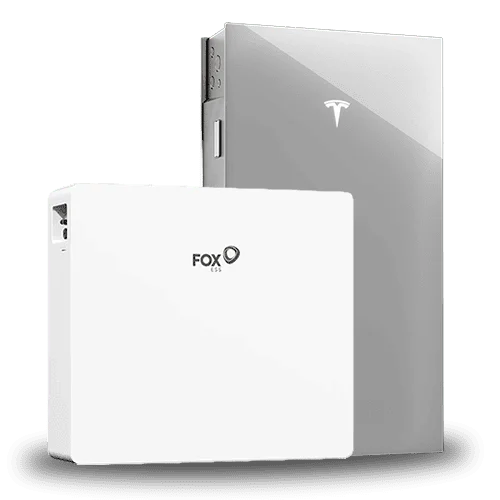
UKEM installs FOX ESS and Tesla Powerwall 3, both listed on the solar and battery storage product page. FOX ESS uses LFP chemistry, handles daily cycling well, and is the workhorse choice. The Powerwall 3 packages battery and inverter into one unit, which keeps the wall install tidy and adds higher continuous power for whole-home backup.

How long do home batteries last?
Modern LFP batteries are rated for around 6,000 charge cycles, with a 10-year manufacturer warranty and 70-80% capacity retention at the end of that period. In practice that’s about a decade of cycling once a day with usable headroom left. UKEM’s 2-year workmanship warranty sits on top of the manufacturer cover.
Will a battery keep the lights on in a power cut?
Sometimes. Look for an Emergency Power Supply (EPS) or backup function in the datasheet. EPS typically powers a few essential circuits (lights, fridge, sockets, router) rather than the whole house. A Powerwall 3 with a Backup Gateway can run larger loads, including a heat pump or EV charger on a reconfigured circuit. If backup matters, flag it at quote stage so the right circuits get wired in.
When a battery doesn’t make sense
Be honest about the list of reasons not to fit one yet:
- You're at home most of the day and already self-consume 70%+ of what your panels generate.
- Your solar system is small (2-3 kWp) and rarely produces a meaningful surplus.
- You're on a single fixed-rate tariff with no off-peak window to exploit.
- You're planning a home EV charger and can schedule charging in the daytime against generation.
Pairing solar with a smart EV charger absorbs a lot of summer surplus without storage at all, and it’s often the better £-per-kWh decision for a household with a daily commute. The home EV charger guide and the SEG section of the 2026 grants guide cover the trade-off.
So, who should add a battery?
If your daytime export is high, your evening use is significant, and you can lock in a sensible export tariff or time-of-use plan, a battery pays back over its warranty period and gives you a quieter relationship with grid prices. If you’re already using most of what your panels generate, or your priority is EV charging, wait. Battery economics improve once the rest of the system is in the right place.
Frequently asked questions
How long does a home battery last?
Can a battery power my home in a power cut?
Can I add a battery to existing solar panels?
Is it better to add a battery or get an EV charger first?
Last updated: