







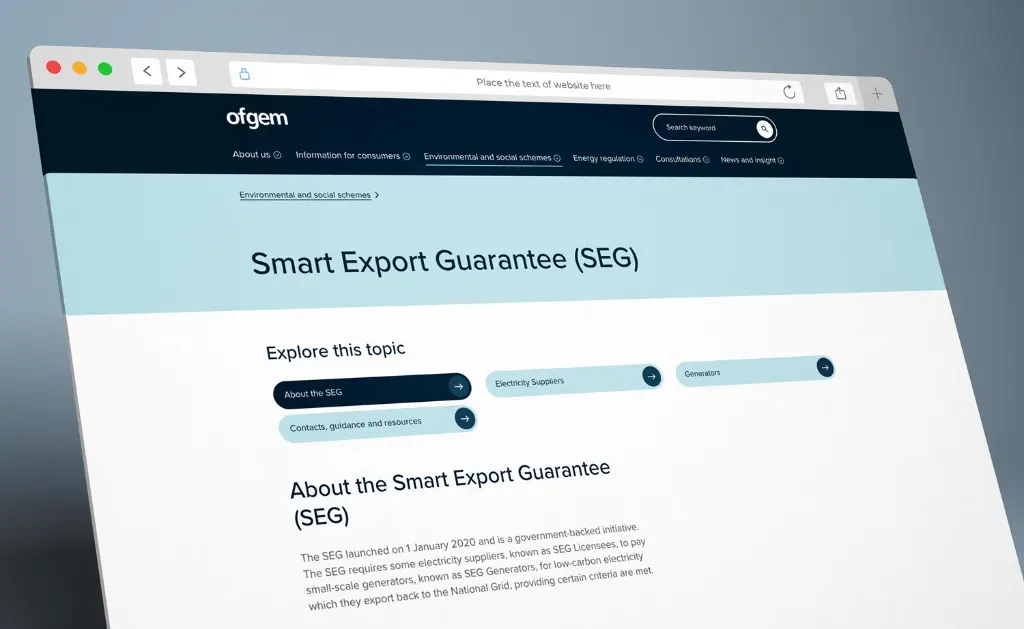
UK solar households received £56.97 million in export payments during the fifth year of the Smart Export Guarantee (SEG), according to Ofgem’s annual report published in December 2025. Generators exported 443.1 GWh of low-carbon electricity to the grid between 1 April 2024 and 31 March 2025, with 270,395 installations registered on a SEG tariff at year end. 99.98% of those were solar PV.
What SEG Year 5 shows
SEG launched in January 2020 after the Feed-in Tariff closed to new applicants. It requires larger electricity suppliers to offer export tariffs above 0p per kWh for certified small-scale generators. Unlike the old FiT, SEG pays only for exported units, not total generation.
Year 5 was the strongest year yet by payment volume:
| Metric | SEG Year 4 | SEG Year 5 | Change |
|---|---|---|---|
| Total payments | ~£30.6m | £56.97m | +86% |
| Electricity exported | ~238 GWh | 443.1 GWh | +86% |
| Installations at year end | ~286,641 | 270,395 | -6% (net registrations) |
| Average tariff rate offered | 8.3p/kWh | 10.8p/kWh | +30% |
The payment jump came from more export volume and higher average tariff rates, not from a sudden flood of new registrations. Solar deployment was already climbing: the UK passed two million solar homes in early 2026.
Tied tariffs vs untied tariffs
Ofgem splits SEG tariffs into two buckets:
Untied tariffs are open to any eligible generator regardless of import supplier or equipment brand. They averaged 4.22p per kWh offered in Year 5.
Tied tariffs require extra conditions (same supplier for import and export, specific battery hardware, time-of-use bundles). They averaged 14.54p per kWh offered, roughly 3.4 times the untied rate.
At year end, 83.8% of registered installations sat on tied tariffs, accounting for 81% of installed capacity. Payments followed the same pattern: £49.24 million (86.4%) flowed through tied tariffs, even though tied installations exported less per system on average because more of their generation was self-consumed or stored.
For a homeowner fitting solar now, the lesson is not “pick the highest export rate on a comparison site and hope.” It is: design the system for self-use first, then choose an export tariff that matches your import supplier and battery setup if you want the tied premium. Our SEG explained guide walks through eligibility and tariff shopping.
Average system size and what you might earn
Year 5 registrations averaged 5.86 kW installed capacity across all tariffs. Most homes in the top export tariffs clustered within 0.75 kW of that average.
Rough income maths for a new 4 kWp rooftop array in 2026:
- Self-consumed solar is worth retail import rates (often 24-28p per kWh on standard tariffs), not SEG export rates.
- Exported surplus on a competitive tied tariff might land in the 10-15p per kWh band; untied deals can sit nearer 4-5p.
- Battery storage cuts export volume but raises the value of each kWh you keep at home, which usually wins financially.
SEG is real money (Year 5 proves £57m flowed to households), but it is the second layer of solar economics after bill savings. Chasing export without sizing self-consumption first is backwards.
MCS certification and why plug-in solar is excluded
Ofgem’s data is almost entirely MCS rooftop PV. SEG eligibility for domestic systems requires:
- MCS-certified installation (or equivalent certification)
- Grid connection approval under G98 (≤3.68 kW per phase) or G99 (larger systems)
- A smart meter capable of half-hourly export readings
- An export MPAN registered with your chosen SEG licensee
Plug-in solar kits up to 800W are a separate regulatory track (see why plug-in sits outside SEG). They do not go through MCS and do not qualify for SEG. Any generation they export is effectively gifted to the grid unpaid. For homeowners with a usable roof, a full MCS install remains the route to both bill savings and export income.
50 tariffs, 11 suppliers
Eleven suppliers offered 50 SEG tariffs during Year 5, with 43 still open to new registrations at year end. The market is competitive, but fragmented: tied bundles from Octopus, British Gas, EDF, and Scottish Power dominate registration counts.
You can hold SEG with a different supplier from your import contract, but the best rates often come from bundles. Switching import supplier purely for 2p more export rarely pays if it lifts your import unit rate.
What this means if you are fitting solar now
The Year 5 report confirms four practical points:
- Export payments are growing. More solar on roofs plus better tariff rates pushed total SEG payments up 86% year on year.
- MCS installs are the gateway. Nearly every pound in the report went to certified rooftop PV, not DIY plug-in kits.
- Design beats tariff chasing. Average systems are ~6 kW; savings come from using your own power first, adding a battery if you want higher self-consumption, then registering SEG with a tariff that fits your setup.
- Check SEG is workable at your address before you commit. SEG is a GB-wide scheme, but registration depends on your meter, your DNO, and your chosen supplier. Before you model payback around a headline export rate, ask the SEG supplier you plan to use whether they can register your property. You need an export-capable smart meter (half-hourly export readings), an export MPAN from your local Distribution Network Operator, and a supplier that accepts your meter type. Smart meter rollout still lags in some rural postcodes, DNO export MPAN times vary by region (often one to four weeks, sometimes longer), and tied tariffs may require a specific import supplier or battery brand. If SEG signup is delayed or a premium tariff is not offered to your address, solar still saves money through self-consumption; export is the second layer, not the foundation. Our SEG explained guide walks through the checks.
UKEM fits MCS-certified solar and battery systems across mainland Britain, handles DNO applications, and can advise on SEG registration once your smart meter is export-ready. Get a solar quote for panels only, or solar and battery storage if you want to shift generation toward self-use.
Further reading: SEG explained | How many solar panels do you need? | Ofgem SEG annual report
Frequently asked questions
How much did SEG pay UK solar owners last year?
Ofgem's SEG Year 5 annual report records £56.97 million paid to registered generators between 1 April 2024 and 31 March 2025. Those payments covered 443.1 GWh of exported electricity, overwhelmingly from rooftop solar PV.
What is the average SEG payment per home?
Payments vary widely by system size, self-consumption, and tariff choice. Ofgem reports 270,395 installations registered at year end and £56.97m total paid across the year, implying a rough average near £210 per year for homes that stayed on SEG throughout Year 5. Homes on higher tied tariffs with larger arrays earned more; small systems on basic untied rates earned less.
Do I need MCS certification for SEG?
Yes. SEG generators must demonstrate suitable certification for installations up to 50 kW. For domestic rooftop solar, that means an MCS-certified install with a compliant grid connection (G98 or G99) and a smart meter that records half-hourly export. Plug-in solar kits and DIY balcony panels do not meet the MCS route and therefore do not qualify for SEG export payments.
What is a tied SEG tariff?
A tied tariff pays a higher export rate when you meet extra conditions, such as taking your import electricity from the same supplier or adding a compatible battery. In Year 5, 83.8% of registered installations sat on tied tariffs, which offered an average 14.54p per kWh compared with 4.22p on untied tariffs. You can switch SEG supplier independently of your import provider, but bundled deals often pay more.
Is SEG available everywhere in the UK?
SEG is a Great Britain-wide scheme, but signing up is not guaranteed on day one. You need an export-capable smart meter, an export MPAN from your local DNO, and a SEG supplier willing to register your meter type. Rollout and DNO processing times vary by postcode; some rural properties wait longer for smart meters or export MPAN creation. Check with your chosen supplier before you model payback around a headline export rate.
Is SEG enough to justify solar on its own?
Export income is a secondary benefit. Most savings come from using your own generation instead of buying at retail rates (often 24-28p per kWh on standard tariffs in 2026). A home battery pushes self-consumption from around 40% toward 70-80%, which usually beats chasing export pence. See our SEG explained guide for how export fits alongside self-use.