








Frequently asked questions
Do I need solar to make a battery worth it?
No. A battery pays back two ways. With solar, it captures surplus you'd otherwise export at 2-16p and lets you use it at 28-30p later, lifting self-consumption from around 40% to 70-80%. Without solar, it charges from a smart time-of-use tariff in a cheap overnight window and runs your home through the evening peak. Both work. The right answer depends on your tariff and when you actually use electricity. See our battery worth-it guide for the full maths.
Which UK tariffs work best with a home battery?
Any tariff with a meaningful gap between off-peak and peak rates. In our 2026 Big 6 comparison, off-peak import runs from around 7p to 14p on tariffs that publish a national unit rate. Some battery-focused plans price their off-peak window as a percentage of the day rate in your region instead, so the figure depends on where you live. Peak import typically sits around 25-30p. The Energy Saving Trust maintains a neutral overview of time-of-use tariffs. The differential matters more than the supplier name. We size your battery against your chosen tariff so the daily cycle pays back.
Will the battery keep my home running in a power cut?
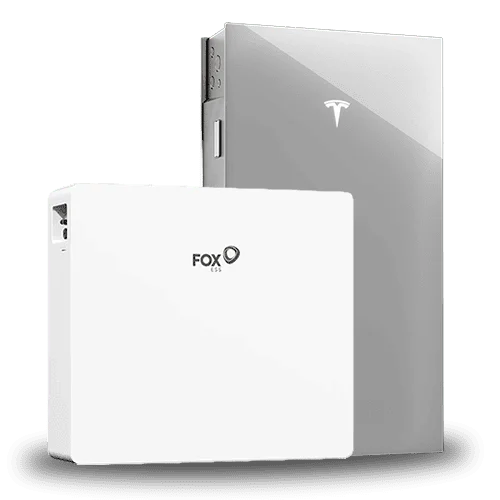
It can, on either brand. Tesla Powerwall 3 installs include the Backup Gateway 2, which switches your consumer unit to battery power and keeps the whole home running through an outage. Fox ESS systems are grid-tied as standard, meaning they pause with the grid under G98/G99 anti-islanding rules, and can add the same cover with the optional Whole-Home Backup (EPS) upgrade. With the upgrade you choose how much charge to hold in reserve for cuts; that reserve does not cycle day to day, so a bigger reserve means smaller daily savings.
AC or DC coupling: which do I need for my existing solar?
For most retrofits, AC coupling. An AC-coupled battery sits alongside your existing inverter and charges from spare power on your house circuit, leaving panels and inverter unchanged. DC coupling uses a hybrid inverter for roughly 5% better efficiency but means replacing the inverter. We default to AC on retrofits unless your inverter is end of life or the efficiency gain pays for the swap. We confirm during the quote.
How big a battery do I need with an EV or heat pump?
Most UK 3-bed homes suit a 10 kWh battery. With an EV, you usually charge the car from the off-peak tariff overnight rather than the battery, since both use the same cheap window. A 10-13 kWh battery covers household use. With a heat pump, we often size 13-20 kWh to bank cheap-rate power for evening heating peaks, often paired with a heat pump tariff. Sizing happens at quote stage.
How does the DNO application work for a battery-only install?
We notify your Distribution Network Operator (DNO) that the battery is being installed. For most domestic batteries on a single-phase supply, this is a G98 notification, which is a post-install notification. Larger systems above the G98 threshold need a G99 application before the install, and the DNO has up to 65 working days to respond. Battery-only is usually simpler than solar+battery because there's no generation export application required. We handle all the paperwork.
Can I add solar later if I start with a battery?
Yes. The battery and inverter you install today work with panels added later. Tesla Powerwall 3 has a built-in solar inverter; Fox ESS uses an H1 hybrid inverter ready for solar input. At add-on time you pay for panels, mounting, and MCS paperwork for the Smart Export Guarantee. Mention solar plans before install so we size the inverter correctly.
Does the Tesla Powerwall 3 need a separate inverter?
No. The Powerwall 3 has a hybrid inverter built in, with three MPPT trackers and support for up to 20 kW of solar input, so it runs your solar array directly with no separate inverter box on the wall. That also makes it a tidy choice when an existing solar inverter is nearing end of life: the Powerwall replaces it and adds 13.5 kWh of storage in one unit.
Which inverter comes with a Fox ESS battery?
A Fox ESS H1 single-phase hybrid inverter, sized at 3.7, 5.0 or 6.0 kW to suit your setup, with up to a 10-year warranty. It manages the battery and any solar panels together, and pairs with Fox ESS EP6 (5.76 kWh) and EP12 (11.52 kWh) battery modules. For AC-coupled retrofits alongside an existing solar inverter, we confirm the right configuration as part of your fixed online quote.
How long do home batteries last and what does the warranty cover?
Modern lithium iron phosphate (LFP) batteries are rated for around 6,000 charge cycles, which works out to roughly a decade of cycling once a day. The standard manufacturer warranty is 10 years and guarantees the battery will hold at least 70-80% of its original capacity at the end of that period. After the warranty most batteries continue running with reduced capacity rather than failing outright. On top of the manufacturer cover, the installation itself is protected for 6 years by an insurance-backed workmanship guarantee.
Can I run my whole house from a battery?
Yes, for short periods. A 10 kWh battery covers typical evening use for around 6-12 hours, less with heavy draws like an oven, immersion heater, or EV charging. Whole-home backup during an outage comes as standard on the Tesla Powerwall 3, which includes the Backup Gateway 2 and supports 11 kW output, or as an optional Whole-Home Backup (EPS) add-on on Fox ESS systems. Most homes use batteries to cut bills, not live off-grid full time.
How much does a home battery cost in the UK?
Standalone home battery installs typically run from around £4,400 to £13,300, from a single Fox ESS EP6 (5.76 kWh) up to a paired Tesla Powerwall 3 (27 kWh) with whole-home backup. The price covers the battery, hybrid inverter where required, isolators, wiring, commissioning, MCS paperwork and DNO notification. A retrofit to existing solar takes around a day. Get a fixed, personalised price through our online quote tool.
Is the 0% VAT on batteries permanent?
No. Battery storage is currently zero-rated for VAT under the energy-saving materials relief. The relief is set to end in March 2027, after which VAT is expected to return to the previous 5% reduced rate. On a £6,000 battery that's still a £300 difference, so installing before the deadline locks in the bigger saving. The relief is automatic, you don't need to apply for it.
Can a battery export to the grid for SEG income?
Not on its own. The Smart Export Guarantee (SEG) pays for surplus electricity you export, and a standalone battery generates nothing to export. With solar, a battery actually reduces SEG income, because more of your generation gets used at home instead of sold back. That trade is usually in your favour, since the import savings are 3-5x larger than the export rate. See the Ofgem SEG page for current rates.
How long does a battery install take?
Most battery-only installs take around a day on site. No scaffolding, no roof access, no DNO solar generation application. The engineer mounts the battery (typically in a utility room, garage, or outside), wires it into your consumer unit through an isolator, commissions the system, and walks you through the app. Quote to install is usually 3-5 days for a standard retrofit once we've been through your photos and the battery you picked. Powerwall 3 installs add around half a day for the included Backup Gateway and circuit reconfiguration.
Is my installation date confirmed when I book online?
Not yet. When you book online you pick a requested installation date and we hold it for you. Once your photos are in, we check that the battery and inverter you picked suits your home and confirm the date within 1 working day. If something needs to change (say a different inverter or consumer unit requirement), we tell you before install day and agree any price difference with you first, or refund you in full. The full detail is in our terms.
Where should the battery be installed?
The most common locations are utility rooms, garages, and outside walls. Batteries are wall-mounted and need a flat, structurally sound surface plus enough clearance for ventilation. Indoor installs need a frost-free room (most batteries derate below 5°C). Outdoor installs use IP65-rated units and are usually mounted in a sheltered spot. We confirm placement during the quote based on cable runs to your consumer unit and where you have suitable wall space.
Can I get a home battery on finance?
Yes. Home batteries qualify for 0% interest finance over 12 to 24 months with a 25% deposit, or longer terms up to 15 years from 9.9%APR Representative with no deposit, subject to status. Finance is through FCA-authorised lenders; UKEM Group is an Introducer Appointed Representative of Shermin Finance Limited. Many households align repayments with time-of-use tariff savings. See how our payment options are structured.
Will applying for battery finance affect my credit score?
No for a quote alone; yes if you apply for finance. Getting an installation price doesn't touch your credit file. A full finance application runs a credit check recorded on your file, and only happens once you choose regulated credit. See our finance and payment options for details.
Do I own the system?
Yes, from day one. It is not a roof lease or a rent-a-roof scheme, and UKEM has no rights over your roof or your battery. If you pay on finance, that is a personal loan in your name. The system is still yours.
What happens if I move home?
The battery stays with the house, so the new owner gets the battery, the MCS certificate and the manufacturer warranties. If it is paired with solar, they can set up export payments with their own energy supplier. Solar usually helps the EPC rating too, which is a plus when you sell. The loan stays with you, not the house. Most people clear it from the sale or add it to the asking price.
How long will a 10kWh battery power my home?
Roughly a full day of normal use. Ofgem's typical UK household uses about 7 kWh of electricity a day, so a 10kWh battery covers an evening peak, overnight and the next morning, while a 5kWh unit covers a typical evening. High-draw appliances shorten that: an electric shower or oven pulls 2-3 kWh in a single use. Heat pumps and EV charging need their own sizing maths.
Do you need planning permission for a home battery?
No, not in most cases. Home batteries are normally installed under permitted development rights in England, Wales and Scotland, whether wall-mounted or floor-standing. The exceptions worth checking: listed buildings, conservation areas, and flats. Your installer handles the paperwork that does apply, the DNO (network operator) notification, as part of the job.
What are the disadvantages of battery storage?
The main disadvantages are upfront cost, storage losses, gradual capacity fade and the space the unit takes up. Payback depends on the gap between your import rate and what you'd otherwise export or buy off-peak. Round-trip losses mean you get back roughly 90% of what you store. Capacity fades to around 70-80% by the end of a typical 10-year warranty. And a battery needs wall or floor space in a garage, utility room or outside.
Last updated: