






For most UK homes in 2026, a heat pump is the cheaper long-term choice once the up to £7,500 Boiler Upgrade Scheme grant is applied and the home is reasonably insulated. A modern air source heat pump delivers heat at 6 to 8p per kWh on a 90 percent efficient gas boiler comparison of around 7.8p, lasts 15 to 20 years against the boiler’s 10 to 15, and cuts the home’s carbon footprint significantly. The gas boiler still wins on upfront cost, on poorly insulated homes that cannot be upgraded, and on properties without outdoor space for the unit. The detailed comparison is below, with three real UK scenarios at the end.
At a glance
How efficient is each system?
A modern condensing gas boiler runs at around 90 percent efficiency. Roughly 90 pence of every pound spent on gas reaches your radiators as heat; the rest is lost up the flue.
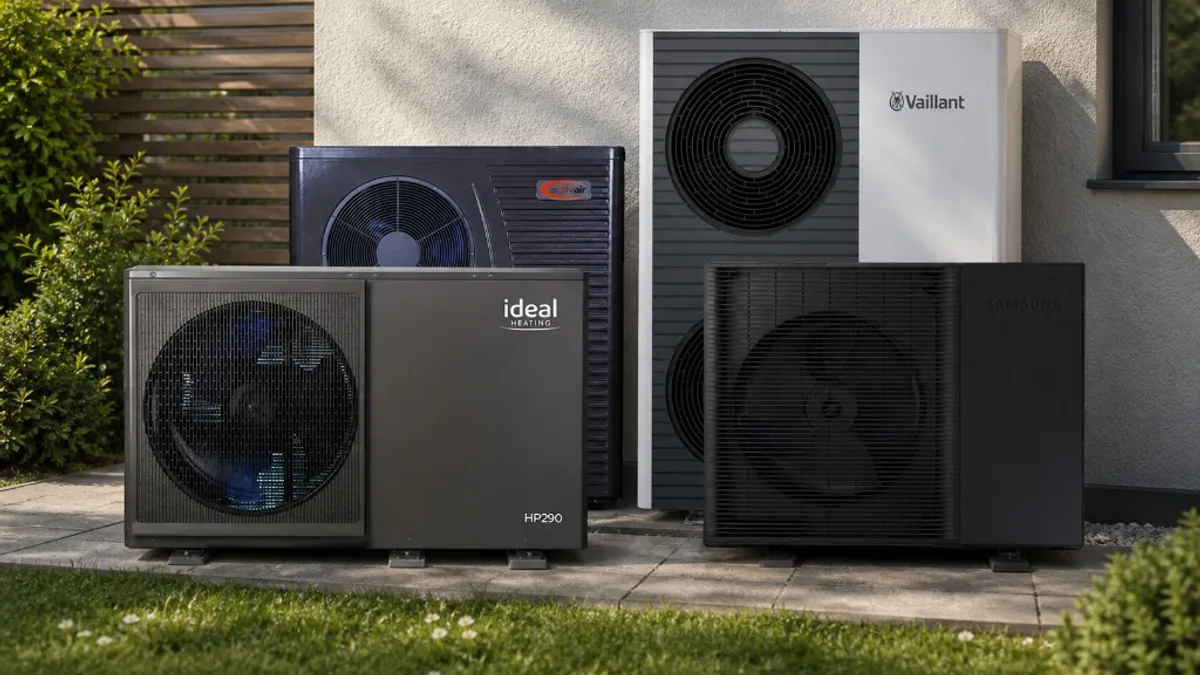
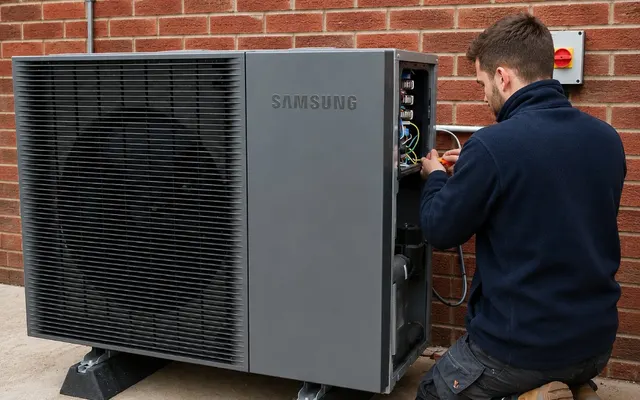
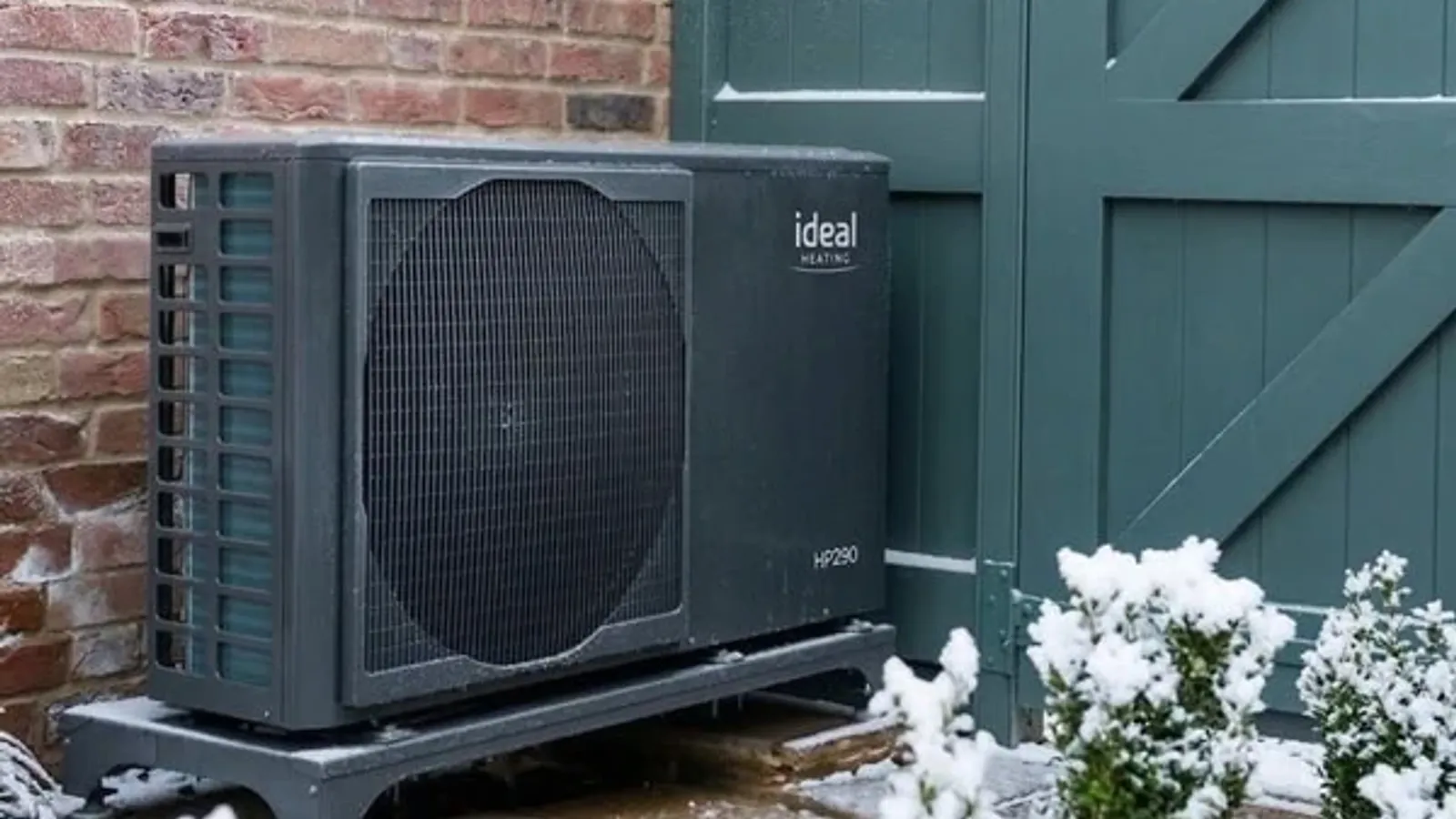
A heat pump runs at 300 to 400 percent efficiency, expressed as a Seasonal Coefficient of Performance (SCOP) of 3.0 to 4.0. It does not generate heat from electricity; it moves heat from outside into the home. Even at -10°C, modern R290 units like the Samsung R290 Gen 7, Vaillant Arotherm Plus, and Ideal HP290 deliver more heat than the electricity they consume, because the outdoor air still contains usable thermal energy. Manufacturer datasheets quote SCOPs up to 4.6 at 35°C flow temperature; real-world averages, accounting for hot water and a real winter, tend to land between 3.0 and 4.0.
The efficiency gap is what closes the cost gap, even though electricity costs more per kWh than gas.
What is the upfront cost, and how does the grant change things?
A new gas combi boiler installed costs in the low four figures, depending on the model and the complexity of the swap. There is no grant.
A heat pump costs significantly more upfront, typically in the low-to-mid five figures before any grant, because the install includes the outdoor unit, an indoor cylinder, pipework changes, any radiator upgrades the heat-loss calc identifies, and MCS sign-off. The Boiler Upgrade Scheme takes up to £7,500 off the headline price when you qualify. Heat pump installations are also zero-rated for VAT until March 2027, which knocks a further chunk off compared to post-2027 pricing.
The net upfront difference after grants is much smaller than the headline numbers suggest. UKEM applies for the grant on the homeowner’s behalf as part of the install, and finance options are available for the residual amount.
What about running costs?
The fairest comparison is cost per kWh of heat delivered into the home, not cost per kWh of fuel. On current UK averages of around 7p per kWh for gas and 24p for electricity:
| Heat source | Efficiency | Cost per kWh of heat |
|---|---|---|
| Modern gas boiler | 90% | ~7.8p |
| Heat pump at SCOP 3.0 | 300% | ~8.0p |
| Heat pump at SCOP 3.5 | 350% | ~6.9p |
| Heat pump at SCOP 4.0 | 400% | ~6.0p |
| Heat pump on Octopus Cosy off-peak | 350% | ~3.9p |
A correctly installed heat pump at SCOP 3.5 already matches gas at standard rates. Move to a heat-pump-friendly tariff (most major UK suppliers now offer one), and the heat pump pulls clearly ahead. There is also the standing charge to consider: if you can drop the gas connection entirely and switch to an electric hob, you save the gas standing charge on top, around £110 a year.
For a deeper worked example with annual figures for a 12,000 kWh demand, see our running costs guide.
A heat pump at SCOP 3.5 on a heat-pump tariff already beats gas. The big variable is whether your home is insulated enough to hit that SCOP.
Will it feel different to live with?
Gas boilers heat water to 60 to 70°C and push it through radiators quickly. You feel the warm-up the moment you turn the system on, and the boiler cycles on and off through the day to maintain temperature.
Heat pumps work at flow temperatures of 35 to 50°C and run in long, gentle cycles instead. The result is a steadier, more even temperature without the sharp on-off swings of a boiler. Most people prefer the feel of it once they adjust, but two things are worth knowing up front. First, the system runs for longer periods; that is by design, not a fault. Second, the warm-up from cold takes longer. The fix is to leave the target temperature at a single sensible setting and let weather compensation manage the rest, rather than treating it like a boiler with manual setbacks.
If radiators are undersized for the lower flow temperature, the system will struggle to warm the room. The MCS survey identifies which rooms need a larger radiator before the install, and the cost is folded into the quote.
Hot water on tap or from a cylinder?
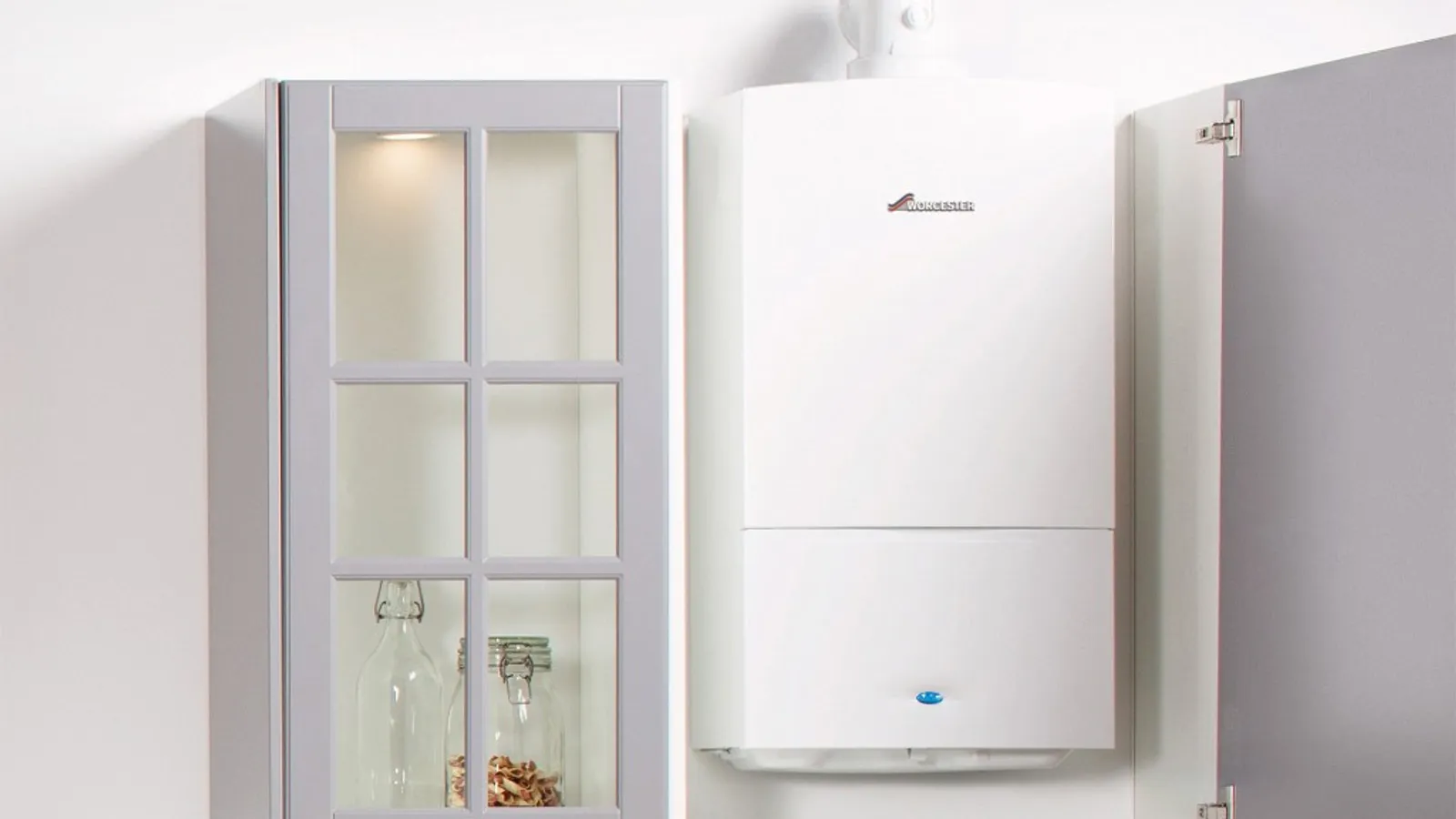
A combi boiler heats hot water on demand. There is no cylinder; there is no waiting; the boiler fires up, you get hot water, the boiler stops. It is the most space-efficient setup for a small home.
A heat pump usually pairs with an unvented hot water cylinder, sized to the household. The cylinder typically lives in an airing cupboard or loft, heated by the heat pump in a long, gentle cycle. For most households this is invisible: a 200 to 250 litre cylinder is enough for a 3 or 4-bed home, with recovery time fast enough that the second person in the shower does not notice. Larger families, or homes with multiple bathrooms running simultaneously, may need a bigger cylinder or a smart schedule that pre-heats before the morning peak. Every UKEM install includes an immersion element on the cylinder as backup.
How loud is a modern heat pump?
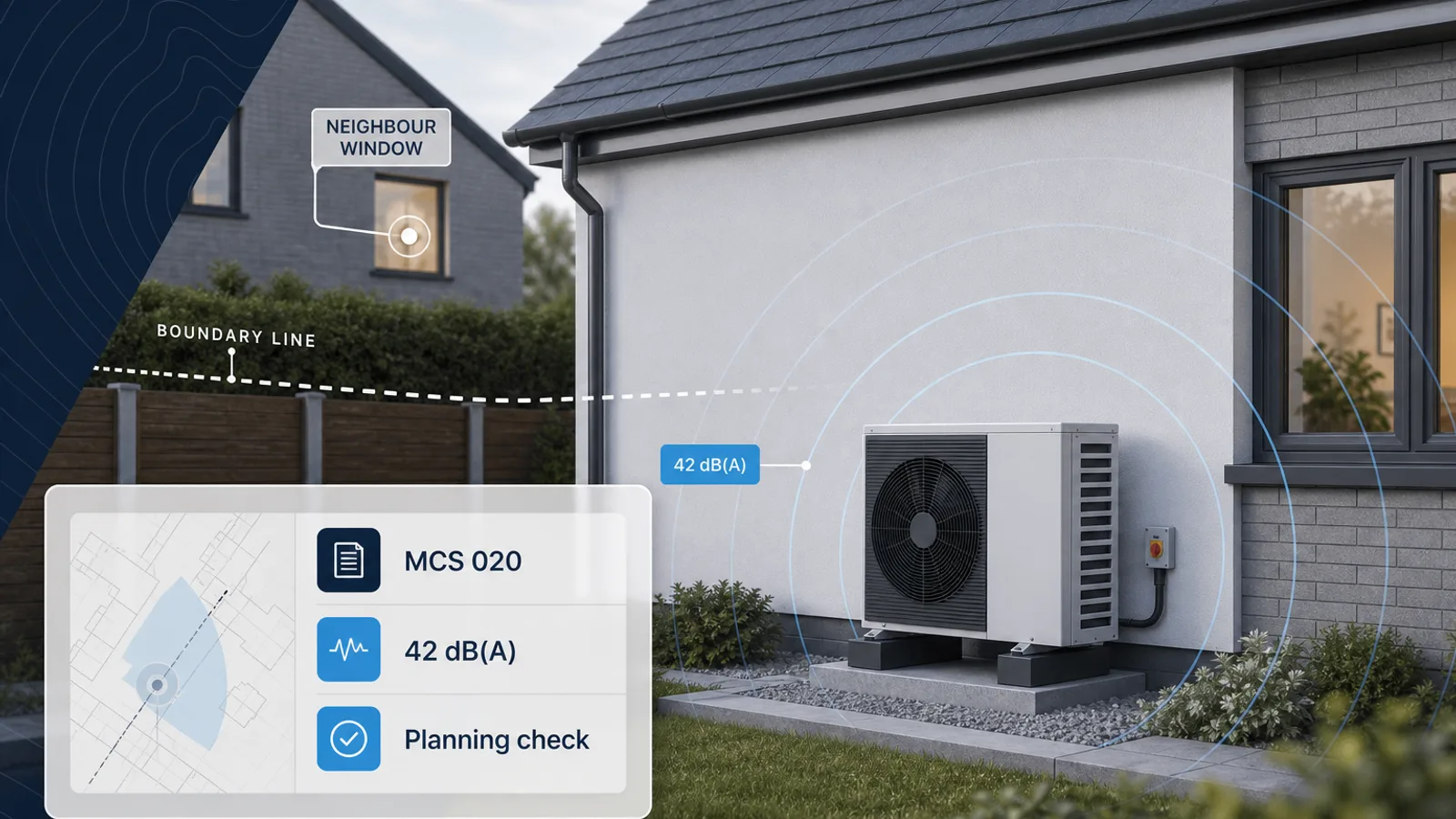
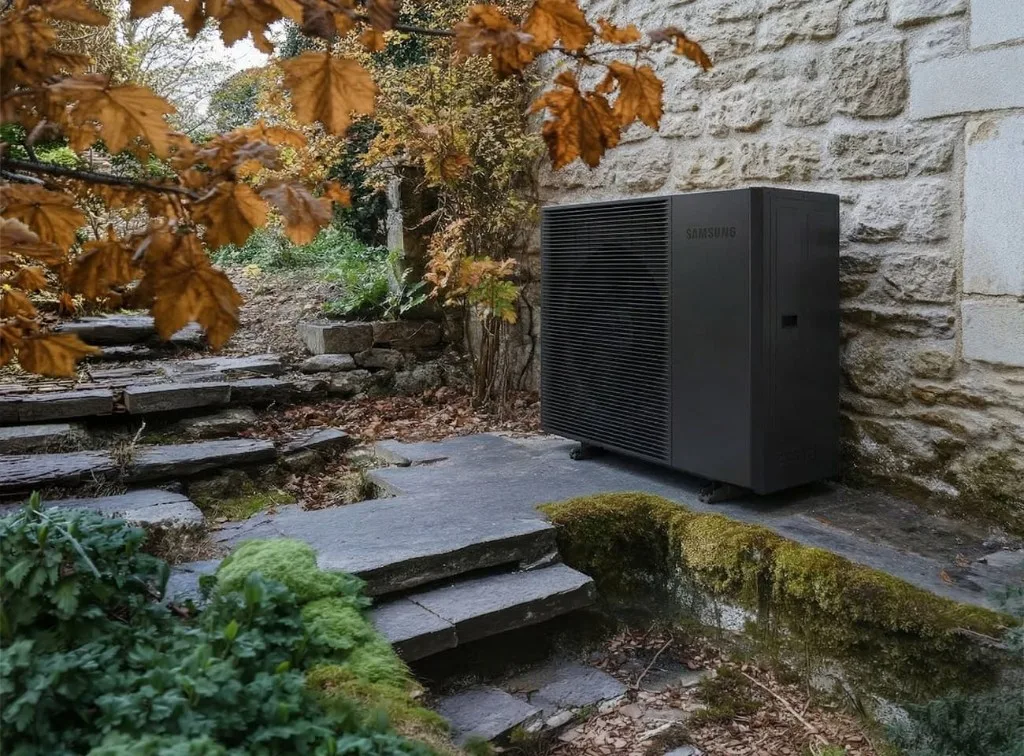
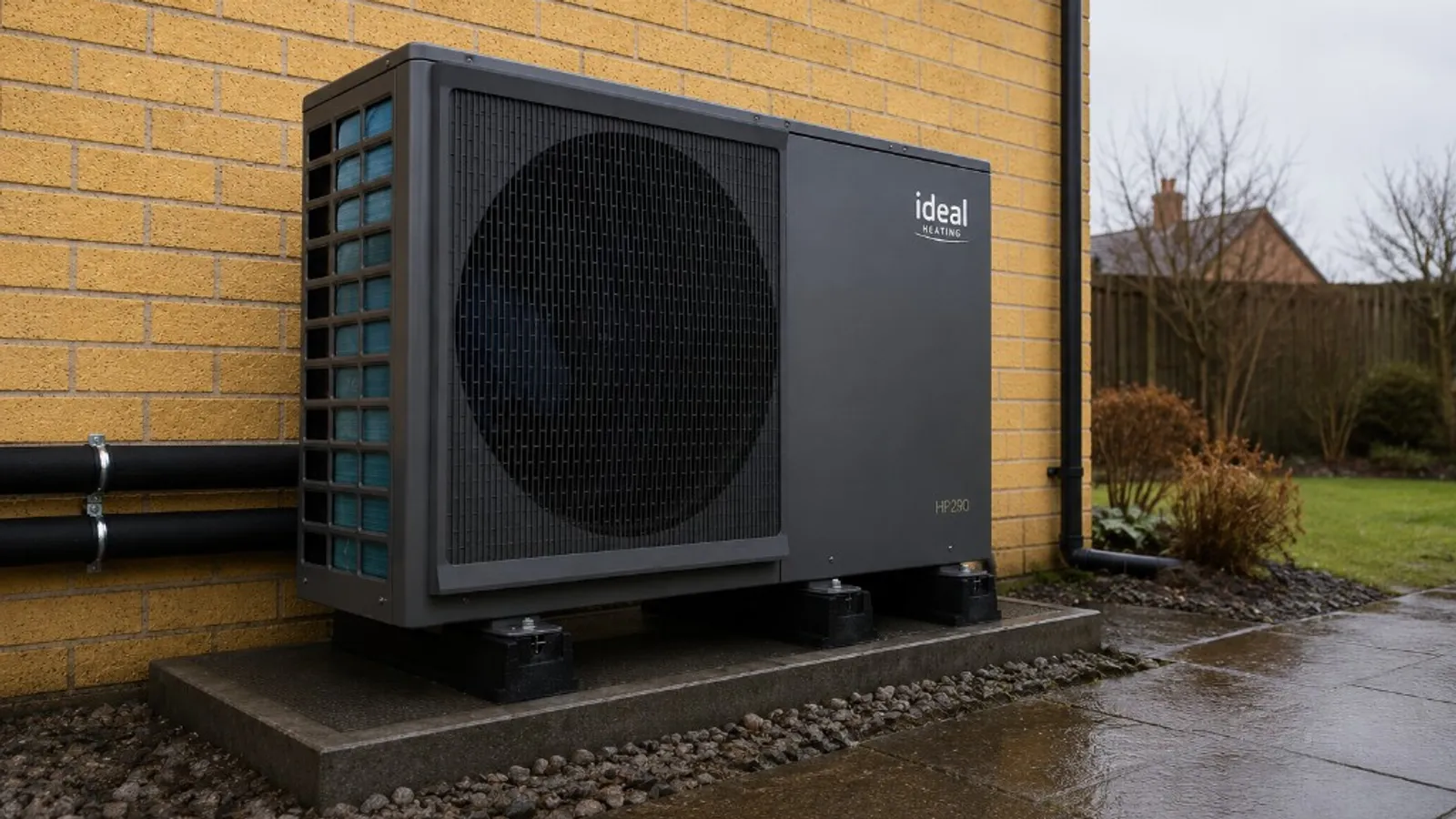
A modern R290 heat pump from Samsung, Vaillant, or Ideal spans about 35 to 46 dB(A) at 1 m on manufacturer sound-pressure data, depending on capacity and mode. That is quieter than most fridge/freezer noise in the same room, and with sensible siting the MCS assessment at the neighbour’s window is normally straightforward. From inside the house, even with the unit mounted on the kitchen wall, you will not hear it from the next room.
Older heat pumps had a reputation for being noisy, and they were. The current generation of R290 units, with variable-speed compressors and quieter fans, has closed that gap.
Where does the unit go, and do I need planning permission?
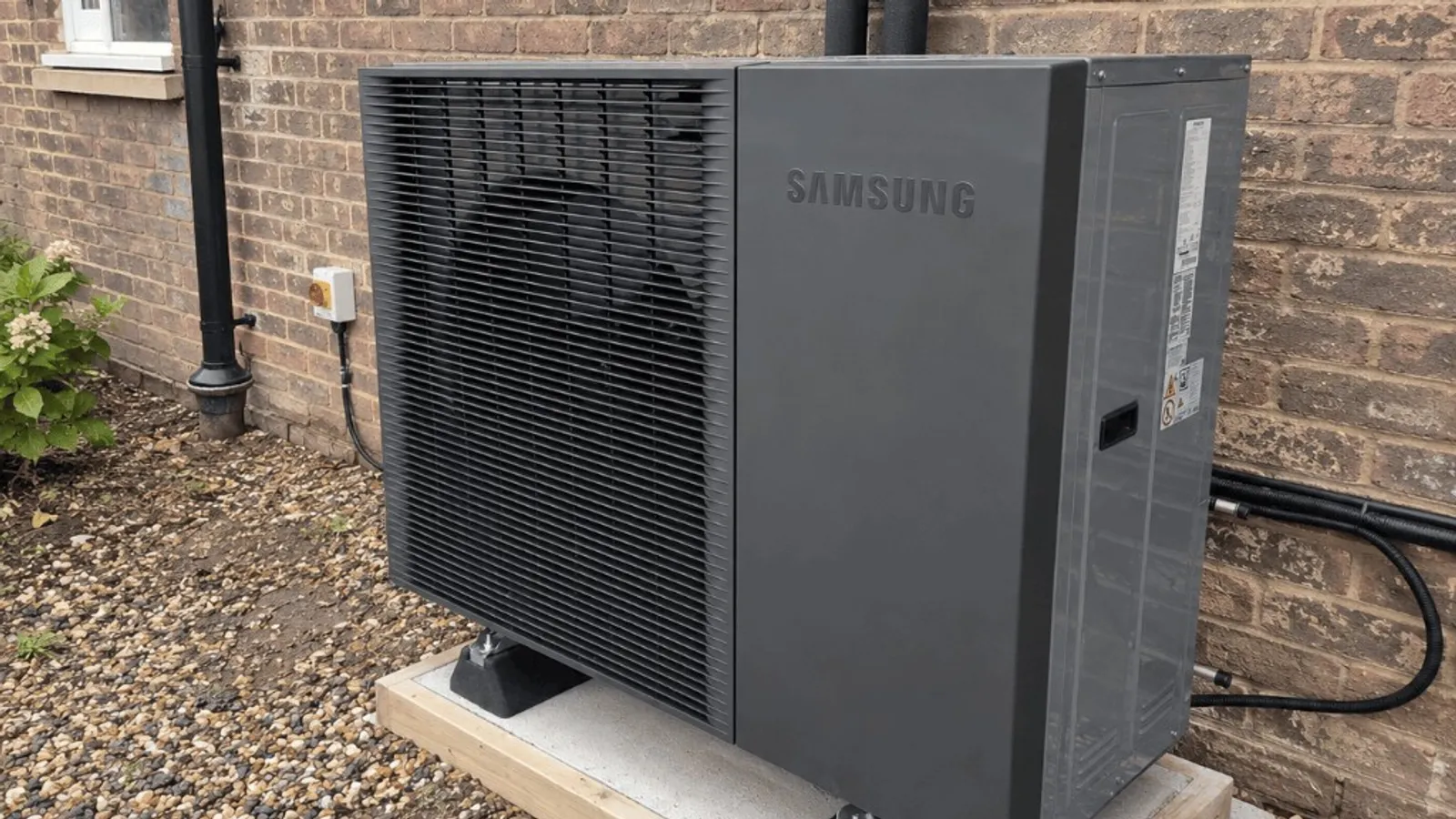
The outdoor unit is roughly the size of a washing machine. It mounts on a wall or sits on a level ground pad, with airflow clearance on the front. A typical setup needs about 1.2m by 0.6m of outdoor space.
Most installations qualify for permitted development under the rules on gov.uk, provided the unit sits more than 1m from the property boundary, is below 1.7m³ in volume, and meets the MCS 020 noise calculation. Listed buildings and conservation areas have stricter rules. The MCS survey checks the conditions against your property and applies for any consent needed.
How long does each system last?
A modern condensing gas boiler typically lasts 10 to 15 years and carries a 7 to 10 year manufacturer warranty when registered and serviced annually.
An air source heat pump typically lasts 15 to 20 years, with a 2 to 10 year manufacturer warranty depending on the brand and the optional extension package. Vaillant and Samsung offer up to 10 years on their R290 ranges with annual servicing; Ideal sits in the same band. Every UKEM install also carries a 2-year workmanship warranty on top of the manufacturer cover. Over 20 years, the average UK home will go through one heat pump and around two boilers.
Which is better for the environment?
A gas boiler burns fossil fuel directly, releasing roughly 0.18 kg of CO2 per kWh of heat delivered. A heat pump runs on electricity. The current UK grid average sits at about 0.16 kg CO2 per kWh of electricity (and falling), which works out to roughly 0.04 to 0.05 kg CO2 per kWh of heat at SCOP 3.5. Across a typical 12,000 kWh annual demand, that is the difference between roughly 2,200 kg of CO2 a year for the boiler and around 500 kg for the heat pump. Add solar panels and the heat pump’s daytime carbon drops further again.
The gap will keep widening. The grid is getting greener as more renewables come online; gas does not get any cleaner.
Side by side
A consolidated view of everything covered above:
| Gas combi boiler | Air source heat pump | |
|---|---|---|
| Annual cost, 12,000 kWh demand | ~£930 (gas) | ~£820 flat tariff, ~£550 heat pump tariff |
| Flow temperature | 60-70°C | 35-50°C |
| Lifespan | 10-15 years | 15-20 years |
| Warranty | 7-10 yrs | 2-10 yrs (manufacturer) + 2 yrs UKEM workmanship |
| Outdoor space | None | ~1.2m × 0.6m plus airflow clearance |
| Hot water | On demand | Pre-heated cylinder, immersion backup |
| Time on site | 1 day | 2-4 days |
| MCS survey | Usually not | Always |
| BUS grant | None | Up to £7,500 when eligible |
| VAT | 20% | 0% until March 2027 |
Three real UK scenarios
Mid-terrace, 1990s build, 2 adults working from home. Cavity wall and loft insulation already in place, double glazing, gas central heating with most radiators sized adequately. This is the textbook heat pump candidate. The MCS survey typically recommends one or two larger radiators in the coldest rooms, the BUS £7,500 grant brings the net upfront close to a high-end boiler upgrade, and running costs match or beat the gas boiler from year one. With Cosy Octopus, the heating bill drops noticeably.
1960s detached, oil heating off-grid, single glazing in places, no cavity insulation. The BUS grant softens the upfront gap once the home qualifies, but insulation has to come first. Without a cavity wall and loft top-up, the home will pull SCOP down into the high 2s, and running costs will not improve much against the oil boiler. The right sequence is insulation, then heat pump (with a generous radiator upgrade) once the heat-loss calc is in a sensible range. The reward is escaping oil deliveries entirely.
1-bed flat with a combi boiler in a kitchen cupboard. Heat pump is rarely the right choice here. There is no outdoor space for the unit, no airing cupboard for a cylinder, and the heat demand is low enough that a new combi boiler stays the cheapest sensible option. A small, modulating combi like the Ideal Logic 2 keeps the kitchen cupboard layout intact and runs efficiently on the small load (the new boiler guide covers what to specify). If the building has a community heat pump scheme, that is a different conversation; for a standalone flat, stick with the combi.
How to choose between the two
Heat pump fits when
- Cavity wall and loft insulation are already in place, or you are willing to do them.
- You have at least 1.2m × 0.6m of outdoor space against a wall or on a flat ground area.
- You can store a hot water cylinder in an airing cupboard, loft, or utility space.
- You are happy with steady-state heating and a 15 to 20 year horizon.
Gas boiler fits when
- The home is poorly insulated and there is no realistic plan to upgrade.
- There is no outdoor space, or planning rules block an outdoor unit.
- You need the lowest possible upfront cost and the BUS grant does not change the picture.
- The existing boiler has failed and a quick like-for-like swap is the only option this winter.
What does the survey involve?
Heat pumps are the only product line UKEM installs that requires an on-site survey before quoting. A boiler-only swap can usually be quoted from photos and a phone call; a heat pump cannot, because the running cost figure depends on heat-loss numbers, emitter sizing, and outdoor unit placement that no remote calculation can verify.
The survey takes about 1 to 3 hours. The surveyor measures every room, calculates design heat loss to MCS standards, identifies which radiators need to grow, locates the best position for the outdoor unit, and checks the noise calculation against neighbouring properties. What comes back is a recommended system, a fixed quote, and the BUS application paperwork started on your behalf. To begin, get in touch with the team.
Closing recommendation
If your home is reasonably insulated and you can use the BUS grant, the long-term economics now favour a heat pump in most cases on the UK mainland. Running costs match or beat gas at sensible SCOPs, with a system that lasts roughly five years longer and a carbon footprint several times lower. If insulation is poor and there is no realistic plan to upgrade, or if outdoor space is genuinely the blocker, a new gas boiler buys you years of efficient heating at the cheapest upfront cost. The right answer falls out of the survey and an honest look at the property. For the day-to-day economics, our running costs guide covers the maths in depth, and the 2026 grants overview walks through every scheme that affects the decision.
Frequently asked questions
Is a heat pump cheaper to run than a gas boiler in the UK?
In a well-insulated home, yes. A heat pump at SCOP 3.5 delivers heat at roughly 6.9p per kWh on current UK averages; a 90 percent efficient gas boiler delivers it at roughly 7.8p per kWh. On a heat-pump-friendly time-of-use tariff, the gap widens to several hundred pounds a year. In a poorly insulated home running at SCOP 2.5 or below, gas can come out cheaper, which is why the heat-loss survey matters before you commit.
Do heat pumps work in winter?
Yes. Modern R290 units from Samsung, Vaillant, and Ideal deliver full rated output down to around -10°C, which covers the coldest days the UK mainland sees in a typical year. They keep working below that with reduced output. Defrost cycles handle frost on the outdoor coil automatically, and a correctly sized system uses weather compensation to lift flow temperature only when it has to.
Do I need to replace my radiators for a heat pump?
Sometimes. Heat pumps run at lower flow temperatures than gas boilers (35 to 50°C against 60 to 70°C), so they need more emitter surface to deliver the same heat output into a room. The MCS-certified survey calculates room-by-room heat loss and identifies which radiators need to grow. In well-insulated homes most radiators stay; in poorly insulated rooms two or three may need an upgrade. UKEM bakes any required changes into the quote up front.
How loud is a heat pump?
Modern R290 units span about 35–46 dB(A) at 1 metre on published sound-pressure tables (Samsung Quiet Mode 35 dB(A); Vaillant aroTHERM plus 5 kW 46 dB(A)). That is quieter than most fridge/freezer noise in the same room and, with sensible siting, normally clears the MCS acoustic check at the neighbour's window. Indoors you will not hear it from another room.
Do I need planning permission for a heat pump?
Most installations qualify for permitted development as long as the unit is more than 1m from the property boundary, sits below 1.7m³ in volume, and meets the MCS 020 noise calculation. Listed buildings and conservation areas have stricter rules. The full conditions are on the gov.uk guidance page. The MCS survey checks the rules against your property and applies for any consent that is needed.
What grants are available for heat pumps in 2026?
The Boiler Upgrade Scheme (BUS) pays up to £7,500 off the install when your property and installer meet the published rules. Heat pump installations are zero-rated for VAT until March 2027. UKEM applies for the BUS grant on the homeowner's behalf as part of the install. Scotland uses Home Energy Scotland instead of BUS; the principle is similar, the application route is different.
Last updated: