





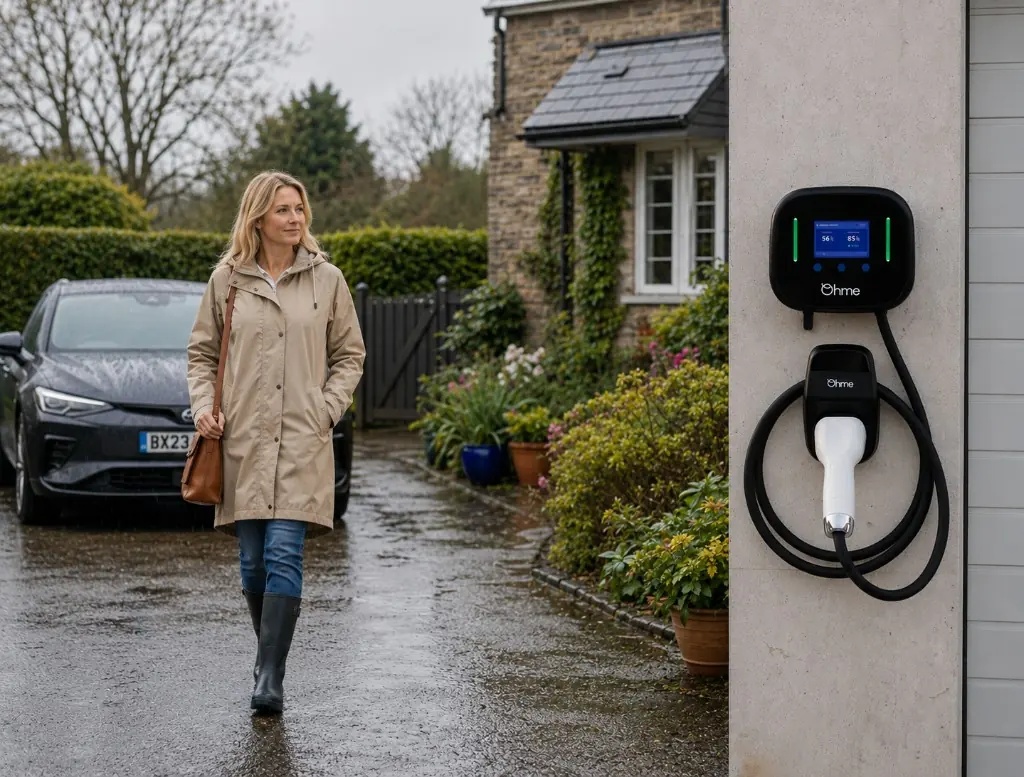
A standard 7.4 kW home EV charger install at UKEM takes about half a day on site, with quote to install around three days. Unlike heat pumps, no survey visit is needed before we fix a price: off-street parking, Wi-Fi at the charger, and photos of your consumer unit are enough for most quotes. On the day, the engineer mounts the unit, runs cable, notifies the DNO, certifies the work, and hands over a working smart charger paired to your app.
At a glance
Before the engineer arrives
- Clear access to the consumer unit and electricity meter.
- Move vehicles so the cable run and wall mount area are accessible.
- Confirm Wi-Fi signal strength at the chosen charger location (smart features need it).
- Have your Wi-Fi password ready for app pairing.
- If you claim OZEV, have eligibility documents to hand; UKEM submits during install.
Parking must be off-street and dedicated to your property. Our guide to home EV chargers lists OZEV rules for renters, landlords, and flat owners.
Step 1: Mount location and cable route
The engineer confirms the final position: height, reach to the car’s charge port, and cable management (tethered unit vs holster). Cable runs from the consumer unit to the charger, often surface-mounted in protective trunking or clipped along walls. Longer runs through multiple rooms add time but follow the same safety rules.
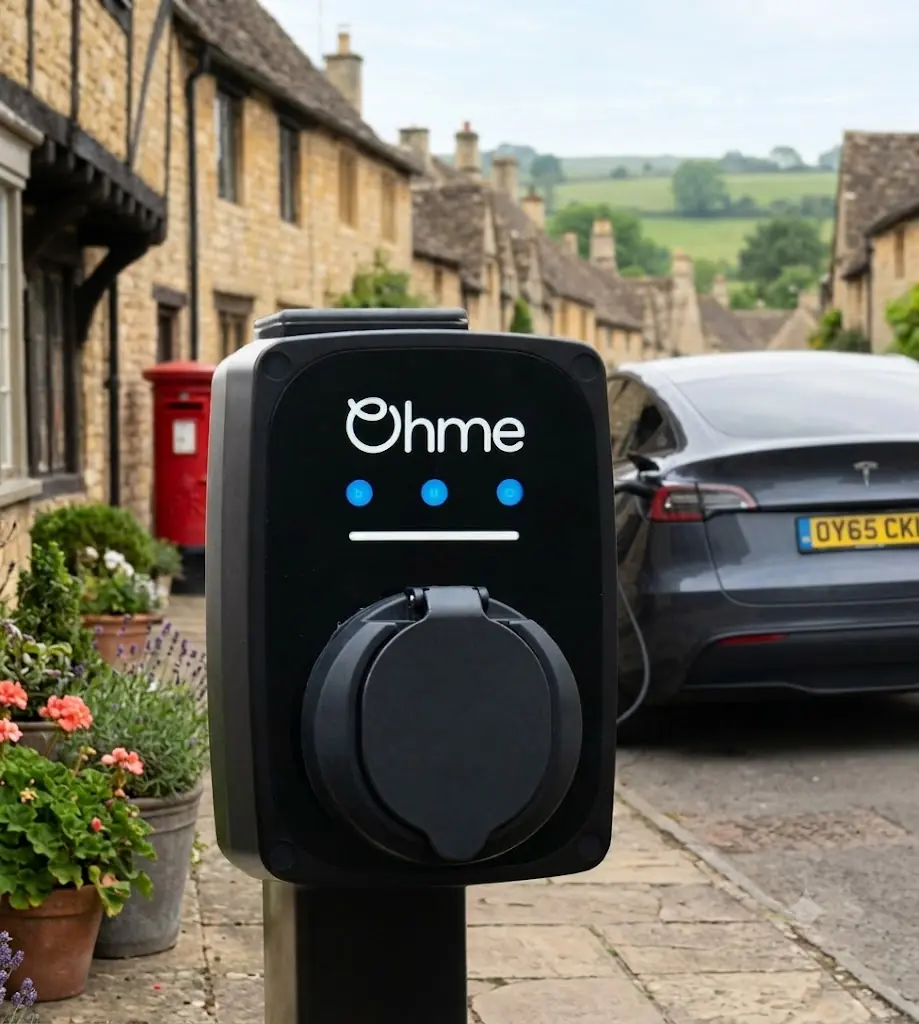
Pedestal mounts suit some front gardens; wall mounts are more common on house or garage walls.
Step 2: Consumer unit and protection
The charger needs a dedicated circuit with the correct overcurrent and RCD protection. If your consumer unit lacks spare ways or does not meet current standards, an upgrade may be included in the quoted scope. The engineer isolates the supply, fits the new circuit, and installs a CT clamp on the incoming tail so the charger can reduce output when the house load is high.
That load management prevents nuisance trips when the oven, shower, and charger run together.
Step 3: Commissioning and app setup
Once wired, the engineer powers the unit, runs functional tests, and pairs Ohme or Tesla app accounts. Smart chargers must default to off-peak scheduling under UK regulations; you adjust windows in the app afterward.
For Ohme, linking your electricity tariff unlocks automatic cheap-rate charging. Tesla Wall Connector setup runs through the Tesla app and integrates with Powerwall if you have one.
Step 4: DNO notification and certification
UKEM notifies the Distribution Network Operator that a new load is connected. You receive NAPIT certification (or equivalent) proving the install meets wiring regulations. Keep the certificate for insurance and future property sales.
If you qualify for OZEV, grant paperwork is submitted in parallel so the discount applies to your invoice. Homeowners who own a house are not eligible; see gov.uk for the current rules.
Handover: your first scheduled charge
Handover covers:
- How to start and stop a session manually
- Setting off-peak schedules
- What the LED or app status indicators mean
- Where the emergency isolator is
- Warranty registration (typically up to 3 years on the charger, plus UKEM 2-year workmanship)
Plug in before the cheap window starts so the car is ready to draw when the schedule opens. Overnight is usually enough to replace a typical daily commute.
When installs take longer
- Consumer unit replacement if the existing board is full or outdated.
- Long cable runs from a distant consumer unit to a front driveway.
- Pedestal installation with ground works.
- Three-phase supplies (uncommon domestically; different hardware).
These are scoped on the quote, not surprises on the day.
What to read next
- Home EV charging costs for tariff and pence-per-mile maths.
- Smart EV charging explained for scheduling and solar features.
- EV chargers product page to compare Ohme and Tesla models.
Frequently asked questions
How long does an EV charger installation take on the day?
A straightforward wall-mounted install on a driveway or garage usually takes about half a day. That includes mounting the unit, running the cable from the consumer unit, installing the protective device, fitting a CT clamp for load management, commissioning the charger, and pairing the app. Longer cable runs, consumer unit upgrades, or pedestal mounts can extend the visit.
Do I need to be home for the whole EV charger install?
Someone over 18 should be home at the start to confirm charger location and at the end for handover. Mid-job access to the consumer unit, meter, and parking spot must stay clear. You do not need to watch every step, but the engineer will walk you through the app and first scheduled charge before leaving.
Will my electricity be turned off during installation?
Yes, briefly. The engineer isolates the consumer unit while connecting the dedicated circuit for the charger. Outages are usually short and planned; tell the engineer if anyone in the house relies on mains-powered medical equipment.
Does UKEM notify the DNO when an EV charger is fitted?
Yes. Grid-connected chargers must be notified to the Distribution Network Operator. UKEM submits notification as part of the install so your supply stays compliant. This is separate from OZEV grant admin but happens in the same project window.
When can I start charging after installation?
As soon as commissioning finishes and the app is paired, usually the same day. Set your off-peak schedule before the first full overnight session so the car draws in the cheap window. The home charging costs guide explains why scheduling matters.