












A gas boiler service is an annual health check carried out by a Gas Safe registered engineer: case off, burner and heat exchanger inspected, combustion analysed, gas pressure and seals verified. Done properly it takes 30 to 60 minutes and costs £80 to £120 for a one-off visit across mainland Britain. It is not a legal requirement for homeowners, but it is a condition of almost every manufacturer warranty, and it is the single best early-warning system for a boiler heading toward replacement. This guide covers what a good service looks like, what it should cost, how it differs from a gas safety certificate, and what to do when the engineer’s verdict points at the boiler itself.
What does a gas boiler service include?
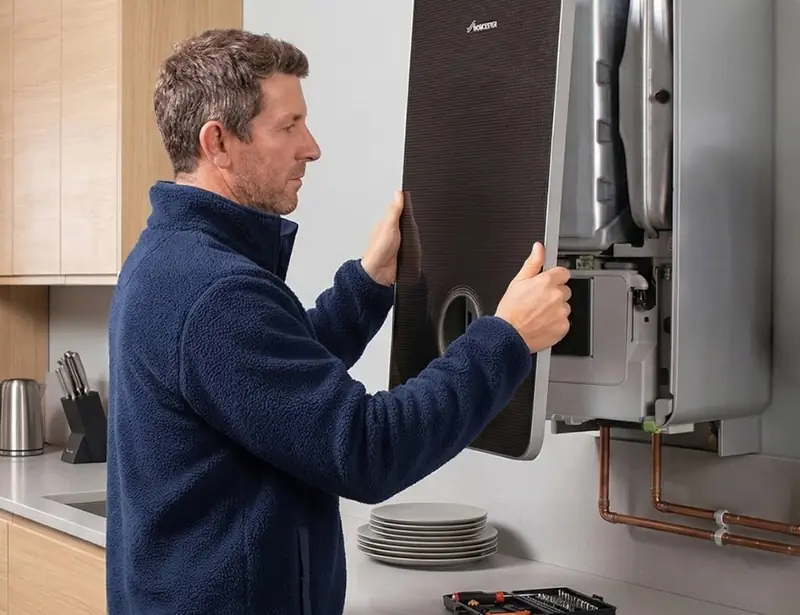
A proper gas boiler service is a hands-on inspection, not a glance and a signature. The engineer should work through all of this:
- Visual inspection. Case, pipework, and flue checked for corrosion, leaks, and signs of distress before anything is opened.
- Case removed. The non-negotiable step. Internal components cannot be inspected through the casing.
- Flue gas analysis. A probe in the flue measures combustion; the printout shows whether the boiler is burning gas cleanly and efficiently.
- Burner and heat exchanger inspected. Checked for debris, corrosion, and cracking, and cleaned where the manufacturer's schedule calls for it.
- Gas pressure and flow checked. Confirms the boiler receives the pressure it was designed for; a common silent cause of poor performance.
- Seals and gaskets verified. Worn seals leak combustion products into the room. This is a safety item, not a nice-to-have.
- Flue integrity and termination. The route is inspected where visible and the terminal checked for blockage and correct position.
- Condensate trap and pipe. Cleared and checked; a frozen or blocked condensate pipe is one of the most common winter callouts.
- Safety devices tested. Flame failure protection and cut-outs are proven to work rather than assumed to.
- Controls and firing test. The boiler is run, brought up to temperature, and its responses checked against spec.
You should finish with a written or digital record of the checks and the flue gas readings. Keep it: the service history is what manufacturers ask for in a warranty claim, and a full folder of them adds credibility when you sell the property.
The 15-minute red flag. If an engineer is in and out in a quarter of an hour and the case never came off, you paid for a visual check, not a boiler and gas service. It happens more than the industry admits, and it is worth knowing what the job should look like before you book one.
How much is a gas boiler service?
Across mainland Britain, a one-off gas boiler service from an independent Gas Safe engineer typically costs:
| Service type | Typical price |
|---|---|
| One-off annual service (independent engineer) | £80 to £120 |
| One-off service, London and South East | £100 to £140 |
| Boiler service and gas safety certificate together (landlords) | £120 to £150 |
| First service after a new install | Often free or discounted by the installer |
The large national names price in the same territory: British Gas advertises its standard one-off boiler service at around the £99 mark and runs lower seasonal offers at quiet times of year. Those offers are genuine, though they are also the front door to being sold a monthly cover plan, so go in knowing which one you actually want.
Two pricing notes worth having in your pocket:
- Summer is cheaper and easier to book. Engineers are quiet between April and September, and some cut prices to fill the diary. Come October the phones do not stop.
- A cheap service that skips the checklist is expensive. The point of the visit is the flue gas analysis and internal inspection. Confirm what is included before you book, not after.
How often do you need a gas boiler service?
Once a year. That is the manufacturer’s schedule, the warranty condition, and the honest engineering answer; annual gas boiler servicing is a large part of why a modern condensing boiler reaches the far end of its 10 to 15 year lifespan rather than the near end.
The warranty point deserves emphasis. New boilers carry manufacturer warranties of up to 10 years, and virtually all of them require documented annual servicing to stay valid. Skip a year and an £80 saving can void several years of parts-and-labour cover on the most expensive appliance in the house.
Book it in spring or summer if you can. You get engineer availability, occasional lower pricing, and any faults surface months before you depend on the boiler nightly. A fault found in June is an appointment; the same fault found in December is an emergency.
Boiler service and gas safety certificate: not the same thing
These two get merged constantly, and the difference matters most if you rent property out:
| Gas boiler service | Gas safety check (CP12) | |
|---|---|---|
| Purpose | Performance, efficiency, longevity | Legal confirmation appliances are safe |
| Legally required? | No | Yes, annually, for landlords |
| Depth | Case off, components cleaned and inspected, combustion analysed | Safety-focused: gas tightness, flue, ventilation, safe operation |
| Output | Service record with flue gas readings | Landlord Gas Safety Record (CP12 certificate) |
A boiler can pass a gas safety check while running inefficiently and drifting toward a breakdown; safe is the floor, not the target. That is why landlords commonly book a gas safety check and boiler service as one combined visit: the CP12 satisfies the law, the service protects the asset, and one callout charge covers both.
If you are a homeowner, nobody will prosecute you for skipping servicing. Your warranty, your gas bill, and your odds of a January breakdown are the enforcement mechanism.
Are gas boiler service plans worth it?
A gas boiler service plan spreads the cost monthly, usually somewhere between £15 and £30 a month depending on provider and what is bundled: annual service only, or service plus breakdown cover, callouts, and parts.
Run the arithmetic before signing. At £20 a month you are paying £240 a year against a one-off service costing £80 to £120. The gap is what you are paying for breakdown insurance, so the question is whether your boiler is likely to claim:
- Newer boiler under manufacturer warranty: breakdown cover is largely duplicating protection you already have. A one-off annual service keeps the warranty alive for a third of the plan price.
- Mid-life boiler, 5 to 10 years: the maths is closer, and a plan can be reasonable if you value a fixed number and one phone number when something fails.
- Ageing boiler past 10 years: read the terms before relying on a plan. Many providers exclude older boilers, cap repair values, or decline units for which parts are no longer stocked; precisely when you would want the cover most.
That last exclusion is the tell. When the insurers who price this risk daily stop wanting your boiler on their books, they are telling you something about where the next few years of repair bills are heading. At that point money is usually better aimed at replacement than at premiums.
Finding a gas boiler service near you
Searching gas boiler service near me returns a wall of ads and directories, so filter it in this order:
- Gas Safe first, always. Working on a gas boiler without Gas Safe registration is illegal in the UK. Check any name on the Gas Safe Register before booking, and check the ID card on the doorstep; the back lists which gas work the engineer is actually qualified for.
- Ask what the service includes. One question, “do you remove the case and run a flue gas analysis?”, separates a real service from a looking-at-it visit.
- Prefer an itemised record. A good engineer leaves you readings and notes, not just an invoice. That paper trail is your warranty evidence.
- Local independents often beat the nationals on price for a straightforward annual service, with the same Gas Safe qualification. The nationals win on plan bundling, which, as above, you may not need.
When a service says replace, not repair
A service is a diagnosis, and some diagnoses do not have a repair-shaped answer. Treat these verdicts as the signal to stop patching:
- The same faults recur year after year. Pressure loss, leaks, or error codes that return after every fix mean the underlying component is failing, not the patch.
- Major parts are wearing out together. A heat exchanger, PCB, or fan on a boiler past 10 years is a repair bill in the high hundreds against a unit with few years left.
- Parts are hard to source. When your engineer starts warning about discontinued components and long lead times, the clock is running.
- Efficiency keeps sliding. Flue gas readings that worsen every year mean rising gas bills; the running costs guide shows what that drift costs.
- It gets an At Risk or Immediately Dangerous label. An unsafe classification on an ageing boiler is rarely worth engineering around.
Past that point, every service fee and repair bill is money spent propping up an appliance on borrowed time. A new boiler resets the clock: modern efficiency, a fresh manufacturer warranty of up to 10 years, and no more holding your breath each October.
That swap is what UKEM does. We fit Worcester Bosch Greenstar 4000 and 8000 Life and Ideal Logic 2 and Vogue boilers across mainland Britain, quoted online or by phone with no survey visit, and most like-for-like combi swaps are done in a day; the boiler replacement guide walks through types, timings, and what an install involves. And if your boiler is on its way out anyway, it is worth a look at whether a heat pump fits your home before you commit to another 15 years of gas: the Boiler Upgrade Scheme takes up to £9,000 off an eligible install in England and Wales, and the heat pump vs gas boiler guide compares the two routes honestly.
Frequently asked questions
How much is a gas boiler service?
How long does a gas boiler service take?
Is an annual boiler service a legal requirement?
What is the difference between a boiler service and a gas safety check?
Can a boiler fail a service?
Is it worth servicing a boiler that is over 10 years old?
Last updated: